Home Backup System – Best Cost Solution For A Portable Solar Generator.

I have been “doing my research” (wandering around the interwebs…), as people so often say these days, on what would be the best cost solution to provide electricity in an extended grid-down situation. I don’t want to spend the money it would cost to provide enough electricity to keep the house running as if the grid were still up – that would cost way more than $10,000 and isn’t a condition we have faced more than once. I live in the middle of the city of Saint Louis, MO, USA and our grid has been, and is likely to remain, pretty reliable, but I expect more outages in the future. So, what’s big enough to run a refrigerator, power our cell phones, some lights and maybe a fan? The best conclusion I can come up with is about 5kWhs of battery storage capability, with a 3kW inverter. I know a fair amount about solar, but not so much about batteries.

Will Prowse is a YouTube content creator who seems rather informed, though it’s not like he’s a professionally educated electrical engineer or an electrician. I can tell he knows a lot more about batteries than I do. I am going to trust his judgement and put together the system he recommends, which should cost me about $2,300 USD before solar panels, which will probably add $800 – $1,000 USD. It’s mobile, if we ever want that capability, it should cover more than just cell phones and LED lights and could provide a minimum level of comfort if the grid goes down for an extended period.

We already own two good sized battery packs – we have electric vehicles, and could draw electricity from them for a bit. The bigger car battery could probably run our large kitchen refrigerator for most of a day, but not a lot else. Of course, you can’t both use the power in the batteries for the house and drive at the same time, so that would have to be thought through in the case of a multi-day grid-down situation.

As you can see in the snippet above (picked up from our utility’s website), during the heat of summer, our house uses as much as 130 kWhs a day of grid-supplied electricity. Yes, that’s a lot; most likely about 75% of that is for central air conditioning. There is no way I want to pay for enough battery backup to supply that seamlessly, even without central air conditioning – just too much money. So the piddly little 5kWh backup system will only provide a minimum amount of our needs. Essentially, the grid goes down and we’re suddenly camping.

I have also looked into buying a used Tesla car battery – a ’21 had gotten into an accident after only using that battery for 3000 miles. I could have gotten that battery delivered to my house for about $4,000 USD, but I didn’t feel confident in my ability to build a backup system using a salvaged Tesla battery, so I stuck with the technically simpler option – the one demo’d by Will Prowse.

I purchased my parts – a 3kW watt all-in-one type inverter, a 5kW server rack battery and ten 300 watt solar panels on 12/14/2023 from Signature Solar, and you can see the prices below. I was told that I needed to order a minimum of 10 solar panels, which was a reasonable fit for this system, so I did, just for convenience. I could/should have shopped a little more for solar panels, but this was good enough.  I think Will Prowse recommends about 1200 watts of solar panel power as input for this system, but the 3kW generated by this string of ten 300 watt panels shouldn’t be too much for the 500 volt limit of the inverter.
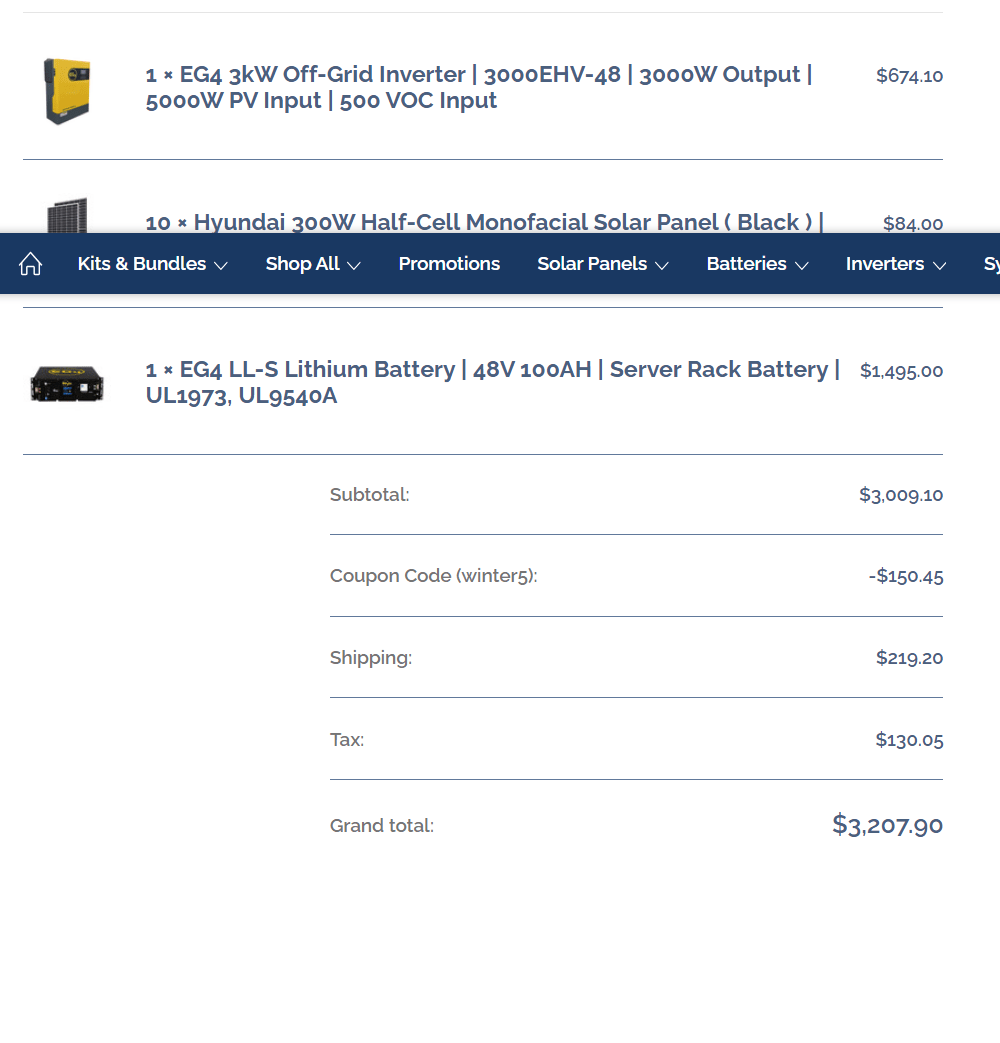
It was a tough decision comparing my various options, but I think this is good enough to meet our needs for now and will have the advantage of lowering our electric bills a bit. BTW, this will be off-grid, not grid-tied. We’ll be powering some of our needs (notably our large kitchen refrigerator) from this system instead of the grid which will decrease the amount of electricity we’re picking up from the grid. The cost of grid-supplied electricity has risen substantially in the last ten years and I expect that will continue. $3,207.90 would buy a whole lot of grid-supplied electricity; the benefit of buying and using this system would be that it would help stabilize our energy costs during the life of this system and be very valuable in an extended grid-down situation. This isn’t the ideal situation for everybody, but it meets our needs.

What do you think? Please let me know if you have any questions or suggestions. And thanks for reading this far! 

My Dad Is Looking Smarter All The Time, And He’s Been Dead For 10 Years.

I just binge-watched all 10 seasons of Homestead Rescue, a ‘reality show’ series on the Discovery+ channel, over the last month. If you haven’t watched it, a man of many talents, Marty Raney, and his two adult children travel to various homesteads around the United States and provide some support, guidance and major construction help to people trying to live ‘a homestead lifestyle’ which usually involves providing most, if not all, of their food, water, energy and security needs from the resources on their homestead property. I won’t drag you through the sad details, but usually these folks have tried their hardest to supply themselves with what they need to survive but have fallen short and need help to get into a better position. My dad didn’t make most of the errors that show up in the episodes of Homestead Rescue, and I never really appreciated how well he did.

My dad was a visionary who was a generation ahead of his time. He was NOT a back-to-the-land hippie, though he shared their interest in living off the land and organic food; he was part of The Greatest Generation and grew up in the city. Even though he was saddled with 11 kids to feed and clothe, he managed to spend some time and effort working on providing heat from wood grown on our property, put a whole lot of beef, chicken and pork in our freezers and grow a lot of organic produce. We built a new house from mostly used materials (bricks, doors, windows, flooring and wood from buildings that were being torn down in the 70’s) and we did that almost entirely without professional help. They had little to no mortgage when we moved into that house in 1974. Dad chose a spot to build the house on top of a large hill, which seems to have prevented so many problems that show up on Homestead Rescue, so we never had water drainage issues. He built a 6 bedroom, sturdy, well-insulated home that has withstood high winds and big storms for over 50 years now. We had big vegetable gardens that produced a lot of food, which we ate, froze or canned. We needed 2 big chest freezers for years to preserve the bounty. With no mentor or a Marty Raney to swoop in to help, we raised chickens, ducks, geese, pigs, goats, cows and a friendly but rather worthless dog. Pops just figured it out, somehow. He always wanted to get solar power, but could never afford it, and never learned about DIY solar thermal. Every episode of Homestead Rescue brought up some issue that Dad had avoided in advance, by good judgement. He bought land in an area with good rains, low predator presence, good roads and proximity to amenities like hospitals and jobs. He got a good deal on the land by buying a big farm with his in-laws, splitting the place into 3 parcels and building a house from used materials.

I highly recommend the Homestead Rescue series, but my dad was one homesteader who never needed them.

Solar Thermal Hot Air Boxes Must Have An Airtight Seal On The Outlet Duct!

There are solar thermal hot air boxes (STHABs) videos and write-ups all over youtube (videos) and BuildItSolar.com (pictures& text) that show how to make them yourselves for maybe a couple hundred dollars USD (or even a lot less if you have the right stuff laying around) but I have yet to find one that includes an airtight seal for the inlet/outlet ducts. An airtight duct seal makes the difference between getting free heat in the dead of winter and getting free heat AND unwanted free freezing air conditioning in the dead of winter. The laws of physics are pretty reliable, and they work the same way during a sunny day and a dark freezing night – air temperature is changed by what the exterior environment is doing to the inside of the the solar thermal hot air box. On a sunny day, the sun sends photons through the glazed front of the solar thermal hot air box, which hits something that changes the sunlight into heat, and thereby heats the air being moved through the STHAB (solar thermal hot air box). In the middle of a freezing cold winter night, the ambient temperature will chill the interior of the STHAB and thereby chill any air that passes through it. You would wipe out any benefits from the daytime heating if you don’t have an air-tight seal covering the exit duct during long winter nights. You might not care about that if the STHAB is just being used to provide heat during the day to a place that won’t be negatively impacted by severely cold weather – for instance, if this is attached to an unheated shed/garage with no plumbing or items that will be damaged by freezing temperatures. This also doesn’t apply to STHABs that are entirely inside a conditioned space – in that case, the cold doesn’t get to it, and it doesn’t become a cold generation machine.

The STHAB shown in my picture is a commercially made box, from Northern Comfort / Sunsiaray, but I think the guy who made them retired in 2018?

I also made one myself, which my brother sort of remade, but that is not as good looking, and probably not as productive, though I haven’t been able to test that carefully. I used two old window sashes that I got for free as the front glazing, which has the benefit of being able to easily withstand the heat generated inside the box on a sunny day, though putting a sheet of Lexan over those window sashes would trap more heat inside the box, and thereby make it more productive. If you do a really good job of building one of these boxes and then put an acrylic or polycarbonate sheet on the front of it, instead of a glass sheet (window sashes, screen door, etc), you run the risk of that potentially expensive sheet melting. I was able to measure temperatures of over 200 degrees Fahrenheit coming out of my homemade STHAB on a sunny day when no fan was running, and how long would polycarbonate or acrylic stand up to that?

This is really great and durable technology, and I encourage you to give it a try, but remember to make sure you have an airtight seal on the ducts when the sun is not shining on it!