Home Backup System – Best Cost Solution For A Portable Solar Generator.

I have been “doing my research” (wandering around the interwebs…), as people so often say these days, on what would be the best cost solution to provide electricity in an extended grid-down situation. I don’t want to spend the money it would cost to provide enough electricity to keep the house running as if the grid were still up – that would cost way more than $10,000 and isn’t a condition we have faced more than once. I live in the middle of the city of Saint Louis, MO, USA and our grid has been, and is likely to remain, pretty reliable, but I expect more outages in the future. So, what’s big enough to run a refrigerator, power our cell phones, some lights and maybe a fan? The best conclusion I can come up with is about 5kWhs of battery storage capability, with a 3kW inverter. I know a fair amount about solar, but not so much about batteries.

Will Prowse is a YouTube content creator who seems rather informed, though it’s not like he’s a professionally educated electrical engineer or an electrician. I can tell he knows a lot more about batteries than I do. I am going to trust his judgement and put together the system he recommends, which should cost me about $2,300 USD before solar panels, which will probably add $800 – $1,000 USD. It’s mobile, if we ever want that capability, it should cover more than just cell phones and LED lights and could provide a minimum level of comfort if the grid goes down for an extended period.

We already own two good sized battery packs – we have electric vehicles, and could draw electricity from them for a bit. The bigger car battery could probably run our large kitchen refrigerator for most of a day, but not a lot else. Of course, you can’t both use the power in the batteries for the house and drive at the same time, so that would have to be thought through in the case of a multi-day grid-down situation.

As you can see in the snippet above (picked up from our utility’s website), during the heat of summer, our house uses as much as 130 kWhs a day of grid-supplied electricity. Yes, that’s a lot; most likely about 75% of that is for central air conditioning. There is no way I want to pay for enough battery backup to supply that seamlessly, even without central air conditioning – just too much money. So the piddly little 5kWh backup system will only provide a minimum amount of our needs. Essentially, the grid goes down and we’re suddenly camping.

I have also looked into buying a used Tesla car battery – a ’21 had gotten into an accident after only using that battery for 3000 miles. I could have gotten that battery delivered to my house for about $4,000 USD, but I didn’t feel confident in my ability to build a backup system using a salvaged Tesla battery, so I stuck with the technically simpler option – the one demo’d by Will Prowse.

I purchased my parts – a 3kW watt all-in-one type inverter, a 5kW server rack battery and ten 300 watt solar panels on 12/14/2023 from Signature Solar, and you can see the prices below. I was told that I needed to order a minimum of 10 solar panels, which was a reasonable fit for this system, so I did, just for convenience. I could/should have shopped a little more for solar panels, but this was good enough.  I think Will Prowse recommends about 1200 watts of solar panel power as input for this system, but the 3kW generated by this string of ten 300 watt panels shouldn’t be too much for the 500 volt limit of the inverter.
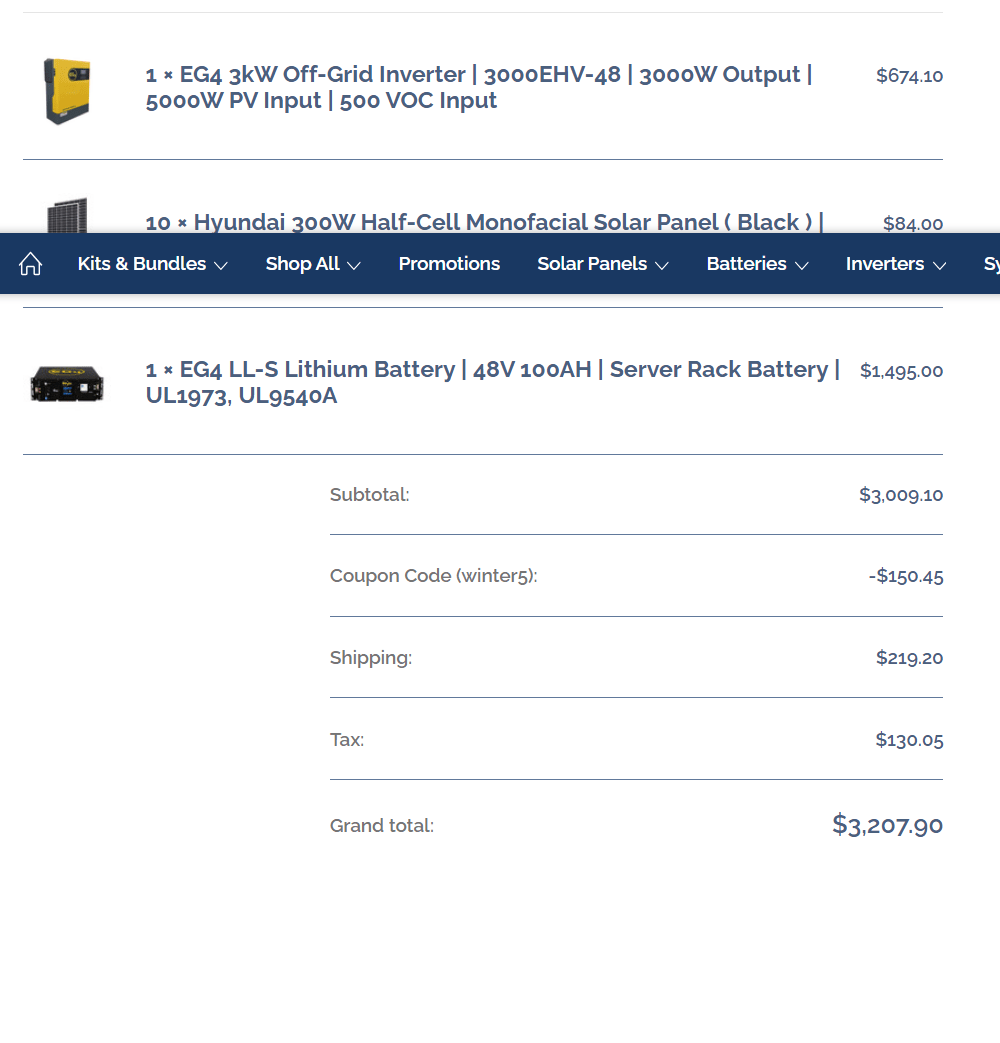
It was a tough decision comparing my various options, but I think this is good enough to meet our needs for now and will have the advantage of lowering our electric bills a bit. BTW, this will be off-grid, not grid-tied. We’ll be powering some of our needs (notably our large kitchen refrigerator) from this system instead of the grid which will decrease the amount of electricity we’re picking up from the grid. The cost of grid-supplied electricity has risen substantially in the last ten years and I expect that will continue. $3,207.90 would buy a whole lot of grid-supplied electricity; the benefit of buying and using this system would be that it would help stabilize our energy costs during the life of this system and be very valuable in an extended grid-down situation. This isn’t the ideal situation for everybody, but it meets our needs.

What do you think? Please let me know if you have any questions or suggestions. And thanks for reading this far! 

Solar Thermal Hot Air Boxes Must Have An Airtight Seal On The Outlet Duct!

There are solar thermal hot air boxes (STHABs) videos and write-ups all over youtube (videos) and BuildItSolar.com (pictures& text) that show how to make them yourselves for maybe a couple hundred dollars USD (or even a lot less if you have the right stuff laying around) but I have yet to find one that includes an airtight seal for the inlet/outlet ducts. An airtight duct seal makes the difference between getting free heat in the dead of winter and getting free heat AND unwanted free freezing air conditioning in the dead of winter. The laws of physics are pretty reliable, and they work the same way during a sunny day and a dark freezing night – air temperature is changed by what the exterior environment is doing to the inside of the the solar thermal hot air box. On a sunny day, the sun sends photons through the glazed front of the solar thermal hot air box, which hits something that changes the sunlight into heat, and thereby heats the air being moved through the STHAB (solar thermal hot air box). In the middle of a freezing cold winter night, the ambient temperature will chill the interior of the STHAB and thereby chill any air that passes through it. You would wipe out any benefits from the daytime heating if you don’t have an air-tight seal covering the exit duct during long winter nights. You might not care about that if the STHAB is just being used to provide heat during the day to a place that won’t be negatively impacted by severely cold weather – for instance, if this is attached to an unheated shed/garage with no plumbing or items that will be damaged by freezing temperatures. This also doesn’t apply to STHABs that are entirely inside a conditioned space – in that case, the cold doesn’t get to it, and it doesn’t become a cold generation machine.

The STHAB shown in my picture is a commercially made box, from Northern Comfort / Sunsiaray, but I think the guy who made them retired in 2018?

I also made one myself, which my brother sort of remade, but that is not as good looking, and probably not as productive, though I haven’t been able to test that carefully. I used two old window sashes that I got for free as the front glazing, which has the benefit of being able to easily withstand the heat generated inside the box on a sunny day, though putting a sheet of Lexan over those window sashes would trap more heat inside the box, and thereby make it more productive. If you do a really good job of building one of these boxes and then put an acrylic or polycarbonate sheet on the front of it, instead of a glass sheet (window sashes, screen door, etc), you run the risk of that potentially expensive sheet melting. I was able to measure temperatures of over 200 degrees Fahrenheit coming out of my homemade STHAB on a sunny day when no fan was running, and how long would polycarbonate or acrylic stand up to that?

This is really great and durable technology, and I encourage you to give it a try, but remember to make sure you have an airtight seal on the ducts when the sun is not shining on it!

Solar Microgrids That Survive Hurricanes?

60 Minutes did a report on how the Bahamas are upgrading their electrical grid to better handle the increasingly violent and increasingly frequent hurricanes hitting their low-lying islands, and I encourage you to watch their video if you can.  If you can’t watch it, you can at least read the transcript at the link above.

It’s incredibly exciting to see progress being made in the search for hurricane-proof solar PV microgrids, and I really hope they succeed.   The solar panels are much closer to the ground in this new type of installation and will supposedly withstand 180 mile-an-hour winds; I think it would be ground-breaking if this microgrid actually does withstand what are expected to being increasingly frequent category 5 hurricanes.   This type of installation will become more in-demand in more places as our world continues to warm.

I do have one quibble about this otherwise well-done presentation and it’s this – Bahamian Prime Minister Hubert Minnis  mentions that he said at the U.N.  ‘First World nations make the greatest contribution to climate change, (t)hey are the ones responsible for the changes that we see. The increase in velocity and ferocity of the hurricanes and the different– and the changes, typhoons that we see today, but we’re the innocent victim. We’re the ones that are being impacted by what you have created.”  Minnis seems to want the U.S. and European countries to contribute to an insurance fund to help rebuild from future storms.  My quibble is this – the electricity generated on these islands is so expensive now that installing solar PV arrays/microgrids even with battery backup will surely cost what they’re already paying now, or, more likely, even cost less.   I could see asking for loans to help with the initial installation of solar, which could be paid back with money paid by electricity customers on their monthly bills.    And I could see asking for some financial help to rebuild after climate-change-influenced storms, but solar is such a good financial move that it would be a freebie /handout to ask for the U. S. and Europe to pay for that.

Ameren Rebates Sort Of Still Available

PLEASE NOTE – the date this was written was July 15th, 2019, so depending on when you read this, it might be very out-of-date.

I just spent a bunch of time on the phone trying to track down the answer to a simple question, so I’m going to put this out there in the unlikely event that anybody can find this post.   My question was – can I get the $0.25 USD/watt rebate that Ameren, the local electric utility, is giving out to people who install solar PV panels on a residence **if I am just adding to an already existing array**?   I was told the answer is maybe, depending on whether money become available, sort of.   To clarify that answer, let me tell you that  we installed an 8.17 kW solar PV array on our home’s garage in 2012 and it has worked almost without incident since then.   We would like to add some solar PV panels to the array in order to further decrease our dependence on electricity mostly generated from coal, so we will be adding 1.71 kW with the addition of 6 new 285 watt SolarWorld panels.   I wanted to know if we could get the advertised solar PV rebate from our local utility if we were adding to an already existing PV system and the person I talked to on the phone said that although all the money available has already been spoken for (which means no money for me, possibly) that if customers who have already been approved for systems fail to install them in a timely fashion that money might then become available for me.  The woman I spoke to about this on the phone said that my application would get in line behind all the other applications hoping to get money, and if enough customers cancelled their orders.  So, the answer is quite dependent on the actions of others, but almost certainly I would get no money from Ameren for extending our PV array.

This rebate is/was only available in Missouri, for customers who get their electricity from Ameren.


Low Cost Lighting, Cell Phone Charging and Radio – KA340 Emergency Lantern

I recommend this device!  I bought a Kaito brand device, KA340, for about $34 from my usual online retail overlord (smile.amazon.com)  and it has a surprising number of features for the low cost.  One issue is that, so far, low cost has meant low amount of power generated and stored. The paperwork included with this device claims it has about 8.5 watts of power storage built in, but  I haven’t been able to verify how much energy this device will store IRL.  The paperwork claims that it’s enough for 14 – 16 hours of light, presumably on a full charge.  If you are able to put it in full sun on a clear sunny day and charge it using the built in .5 (yes, that’s one half) watt solar PV panel, with about 5.5 “peak sun hours” (not the same as daylight hours) in the summer (in Saint Louis, MO USA), you’d only be able to pick up about 2.75 watts of energy per day….so maybe you’d have to charge it for 3 days to fill the tiny batteries???  How in the world do they get away with such tiny PV panels and battery packs, you ask?  If you charge it all day, in good sun, that’s still enough for several hours of light, which most people will accept.  It probably takes about 5 watts to charge a cell phone, so if you want light AND cell phone charging you are going to spend a very long time using the hand crank as an energy input.   Beware – there’s no indication that this is waterproof – keep it in a sealed ziploc bag if there’s any chance it could get wet – rained on, spilled on, etc.    Please check out this review – this guy does a pretty good job of describing the features.