Happy Leaf LED + 6 Mason Jars

Written 2/27/2020 in Saint Louis, MO USA

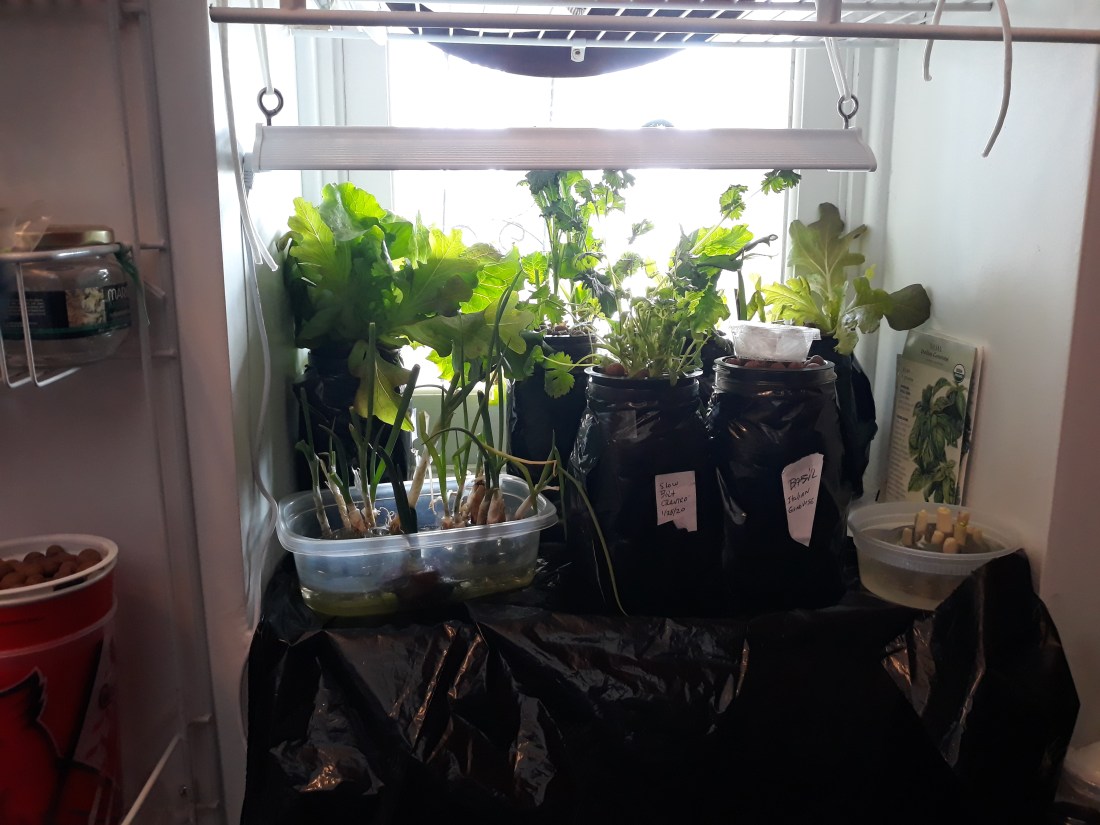
I bought a grow light from Happy Leaf LED and a small hydroponics kit (baskets and clay pebbles, a few seeds) and this is what I now have 4 weeks after setting this up (see picture).  The kit from Happy Leaf LED didn’t include the fertilizer that needs to be added to water put in the jars – I bought that from Amazon  for $17 USD.  The sunlight from the window is probably useless; I think all the growing is due to the grow light. The light and 6 black plastic baskets to sit in the top of my mason jars, the pebbles and about 20 lettuce seeds cost about $100 on sale, and most of that cost was the made-in-America light. I think that light is about 17″ long and cost about 5 cents a day in electricity to run for 16 hours (electricity is about $0.10/kWh in the winter in Saint Louis and the Kill A Watt meter said it used .43 kWh for one 16 hour period).  I put seeds of my own in 3 jars – kale, cilantro and basil. Basil barely came up at all and then died; lettuces, kale and cilantro did pretty well.  The picture with this post shows the plants after I harvested enough for 2 salads, so the growth was about double what is shown.   All the growth after 4 weeks is good for about enough salad for 4 people, so since we want at least twice that per week, I might need to double the number of jars per week to grow what we want on a continuing basis.  And since it takes about 4 weeks to get to this point, does that mean that I’d have to have 32 mason jars, one set of jars planted each week, to have a steady supply of the salad that we want?  I’ve got a lot of questions still unanswered about this process and  I’m not sure how to do the financial analysis on this – do we harvest all from each jar and then have to replant, or would the cut-and-come-again capabilities of these plants mean that I’d only need half as many jars as I’m thinking?  How many jars can this one light manage?   How long until this system pays for itself/breaks even?   How tall a space do we need to deal with these plants?   Btw, the onions growing in the foreground in the picture are seated in old glass floral frogs – see my previous post about that for more information.  I’ll post again when I have more data to share.   Thanks for reading this!

Regrowing Green Onions With Vintage Glass Floral Frogs!

I have tried and failed so many times to re-grow green onions but finally found some success, and I want to share this tidbit with others.  I tried half a dozen times to re-grow green onions but they always rotted.  I tried different containers – same result.   On a whim I put the one inch bottom stem pieces that I had cut off the long green onions  into a vintage glass floral frog and this kept the onion stems from rotting, like they had so many times before.   I have to change the water out every couple of days, but I just use tap water and that has worked out fine so far.  Just so you get a better idea of what a vintage floral frog looks like – click here.  I have no association with that page, I’m just including the link so people can get a better idea of what floral frogs look like.  Hope this helps somebody!

Ameren Rebates Sort Of Still Available

PLEASE NOTE – the date this was written was July 15th, 2019, so depending on when you read this, it might be very out-of-date.

I just spent a bunch of time on the phone trying to track down the answer to a simple question, so I’m going to put this out there in the unlikely event that anybody can find this post.   My question was – can I get the $0.25 USD/watt rebate that Ameren, the local electric utility, is giving out to people who install solar PV panels on a residence **if I am just adding to an already existing array**?   I was told the answer is maybe, depending on whether money become available, sort of.   To clarify that answer, let me tell you that  we installed an 8.17 kW solar PV array on our home’s garage in 2012 and it has worked almost without incident since then.   We would like to add some solar PV panels to the array in order to further decrease our dependence on electricity mostly generated from coal, so we will be adding 1.71 kW with the addition of 6 new 285 watt SolarWorld panels.   I wanted to know if we could get the advertised solar PV rebate from our local utility if we were adding to an already existing PV system and the person I talked to on the phone said that although all the money available has already been spoken for (which means no money for me, possibly) that if customers who have already been approved for systems fail to install them in a timely fashion that money might then become available for me.  The woman I spoke to about this on the phone said that my application would get in line behind all the other applications hoping to get money, and if enough customers cancelled their orders.  So, the answer is quite dependent on the actions of others, but almost certainly I would get no money from Ameren for extending our PV array.

This rebate is/was only available in Missouri, for customers who get their electricity from Ameren.


Solar PV Since 2012

We installed an 8.17kw PV array on our garage in 2012 and it has worked almost without incident since then.   I retrained to be a solar installer in the extremely hot summer of 2012 and passed the entry level NABCEP certification test with the highest score of anybody in my class (yay me!) so I was able to design our system myself.  We had scraped together the money to buy the solar panels we needed in November of 2011, but I didn’t know enough at that point to design our system, so our modules sat and waited until August of 2012 to be installed.   I worked with my (now) late brother Robbie to design custom racking for our array because we wanted to create a prototype racking that was low cost, extremely sturdy, and a good fit for DIY’ers to make themselves from commonly available and affordable materials.  Most commercially available racking lifts solar panels about 4 inches above the roof to allow a little airflow, but not higher, and I think that’s mostly for aesthetic reasons.   In other words, when solar panels get hot they don’t produce as much electricity, and lifting them higher off of a hot roof would allow more airflow to cool the panels, theoretically allowing them to produce more electricity in the heat of the summer.  The racking I designed allowed 10 inches of space under the panels, allowing for a lot more airflow.   I can’t prove that this has actually increased the output of our solar array, or how much it might have improved output, so I can see where others might not find this very impressive.  I will add pictures to this post at a future date.    We installed 38 Evergreen Solar 215 watt modules paired with SolarEdge DC power optimizers, and two 5000 watt SolarEdge inverters.     We recently purchased some Solarworld 285 watt panels and will probably add 6 of them to the existing array.

This Guy Is Living The Solar PV Dream!

It would be more accurate to say that this guy – LaMar  Alexander – is living one possible solar PV dream.  He became homeless in the late 90’s and decided that he was going to build his own off-grid 14′ x 14′ cabin using cash and recycled materials, so that he would be debt free.  The cabin is pretty basic but provides a modern lifestyle for a fraction of what most people are paying now, while allowing him to live without a mortgage or utility bills.  If you’re interested in learning more about how to live a more independent energy lifestyle on a tiny budget, this guy is the one to watch.  He did it for himself and has spent years sharing this information with others.  You can check out his website or view his videos on his youtube channel.   One of the things he figured out is that PV isn’t actually enough in most parts of the U.S. – you probably need to install some sort of wind power to get energy during the winter months.  Most people seem to build these tiny off-grid buildings in rural areas like Mr. Alexander seems to have done, but this can be done in the city, too!  I visited an off-grid house in north Saint Louis city some years ago though I can’t find any reference to it online now, but I’m sure there are an increasing number of people doing this in the city, too.  So you probably have choices you don’t even realize!  How much would YOU like to live without a mortgage?  The right solar equipment might help you do that.