
Tag: Cheap
Maple Syrup Flavored Hot Chocolate From The Tree In Front Of My House!


This is now the third year that I have tried to harvest sap from the tree in front of our house in the middle of the City Of Saint Louis, and I finally had a tiny bit of success. Like, one quarter cup of success. We installed a sap tap on two different maple trees yesterday (Saturday, January 25th, 2025) and by today (Sunday, January 26th, 2025) had harvested 8 cups of sap. I cooked that down to about one quarter cup of maple syrup, which sure looks like almost nothing. After cooking the sap down to syrup it seemed like there was too much maple syrup still clinging to the pan so I decided to make good use of that by warming milk in that pan, which dissolved the syrup that had been solidified onto the pan, and that worked very well. Added cocoa powder and a quarter teaspoon of vanilla and I had a cup of hot chocolate, sweetened by syrup that had come out of a tree that same day. Kinda cool.
Home Backup System – Best Cost Solution For A Portable Solar Generator.
I have been “doing my research” (wandering around the interwebs…), as people so often say these days, on what would be the best cost solution to provide electricity in an extended grid-down situation. I don’t want to spend the money it would cost to provide enough electricity to keep the house running as if the grid were still up – that would cost way more than $10,000 and isn’t a condition we have faced more than once. I live in the middle of the city of Saint Louis, MO, USA and our grid has been, and is likely to remain, pretty reliable, but I expect more outages in the future. So, what’s big enough to run a refrigerator, power our cell phones, some lights and maybe a fan? The best conclusion I can come up with is about 5kWhs of battery storage capability, with a 3kW inverter. I know a fair amount about solar, but not so much about batteries.
Will Prowse is a YouTube content creator who seems rather informed, though it’s not like he’s a professionally educated electrical engineer or an electrician. I can tell he knows a lot more about batteries than I do. I am going to trust his judgement and put together the system he recommends, which should cost me about $2,300 USD before solar panels, which will probably add $800 – $1,000 USD. It’s mobile, if we ever want that capability, it should cover more than just cell phones and LED lights and could provide a minimum level of comfort if the grid goes down for an extended period.
We already own two good sized battery packs – we have electric vehicles, and could draw electricity from them for a bit. The bigger car battery could probably run our large kitchen refrigerator for most of a day, but not a lot else. Of course, you can’t both use the power in the batteries for the house and drive at the same time, so that would have to be thought through in the case of a multi-day grid-down situation.

As you can see in the snippet above (picked up from our utility’s website), during the heat of summer, our house uses as much as 130 kWhs a day of grid-supplied electricity. Yes, that’s a lot; most likely about 75% of that is for central air conditioning. There is no way I want to pay for enough battery backup to supply that seamlessly, even without central air conditioning – just too much money. So the piddly little 5kWh backup system will only provide a minimum amount of our needs. Essentially, the grid goes down and we’re suddenly camping.
I have also looked into buying a used Tesla car battery – a ’21 had gotten into an accident after only using that battery for 3000 miles. I could have gotten that battery delivered to my house for about $4,000 USD, but I didn’t feel confident in my ability to build a backup system using a salvaged Tesla battery, so I stuck with the technically simpler option – the one demo’d by Will Prowse.
I purchased my parts – a 3kW watt all-in-one type inverter, a 5kW server rack battery and ten 300 watt solar panels on 12/14/2023 from Signature Solar, and you can see the prices below. I was told that I needed to order a minimum of 10 solar panels, which was a reasonable fit for this system, so I did, just for convenience. I could/should have shopped a little more for solar panels, but this was good enough. I think Will Prowse recommends about 1200 watts of solar panel power as input for this system, but the 3kW generated by this string of ten 300 watt panels shouldn’t be too much for the 500 volt limit of the inverter.
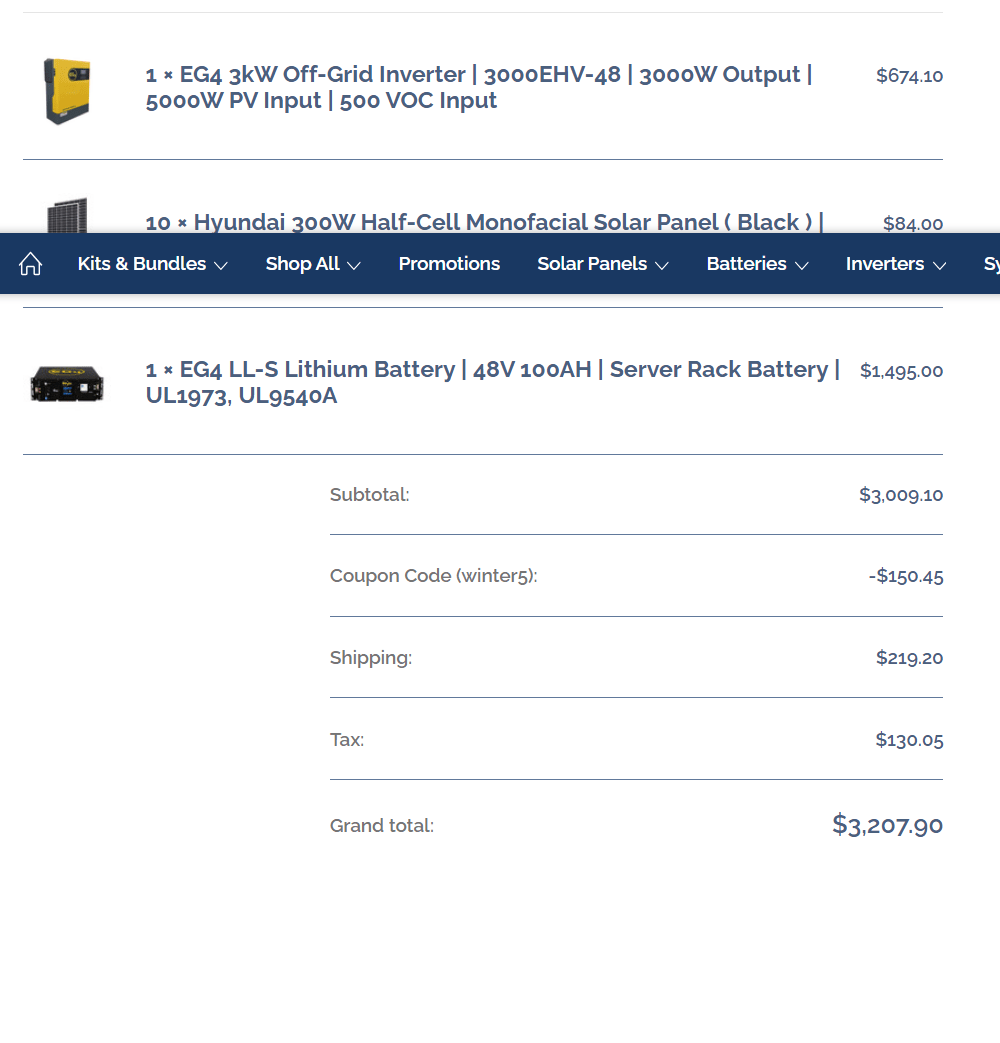
It was a tough decision comparing my various options, but I think this is good enough to meet our needs for now and will have the advantage of lowering our electric bills a bit. BTW, this will be off-grid, not grid-tied. We’ll be powering some of our needs (notably our large kitchen refrigerator) from this system instead of the grid which will decrease the amount of electricity we’re picking up from the grid. The cost of grid-supplied electricity has risen substantially in the last ten years and I expect that will continue. $3,207.90 would buy a whole lot of grid-supplied electricity; the benefit of buying and using this system would be that it would help stabilize our energy costs during the life of this system and be very valuable in an extended grid-down situation. This isn’t the ideal situation for everybody, but it meets our needs.
What do you think? Please let me know if you have any questions or suggestions. And thanks for reading this far!
Frost Looming? Bring In Those Green Tomatoes!


November 2nd, 2023 – USDA Hardiness Zone 6B (always check the zone when reading about gardening! What the author is saying might not apply to your location at all if they’re in a very different growing zone)
A hard frost ended the season here this week – temperatures below freezing for two nights in a row meant the end of the road for our outdoor tomato ambitions. I’m just putting up this blogpost to either remind or inform people that green tomatoes will (or at least might) ripen nicely if they’re brought in before the first freezing temperatures of the season and stored correctly. I did that for the first time last year and was pleasantly surprised at how well that worked out. Even very green tomatoes ripened nicely and were completely usable. The video that I watched on Youtube showed that tomatoes should probably not be stacked more than a single layer high; I stacked some in two layers (small tomatoes) and it seemed to be ok.
This blogger says that completely immature and shiny tomatoes will not ripen, which is bad news because this year most of the green tomatoes that I brought in are completely immature and shiny. I’ll do an update to report back whether the green tomatoes from this year ripened as well as the ones from last year. The pictures shown above are the tomatoes from last year (2022) in the picture on the left, and our 2023 crop of greenies on the right.
Don’t let those laggard tomatoes go to waste!
I’m A Bloomsday Prepper And You Should Be One Too!

Are you as tired of bad news as I am? There is just no shortage of bad news related to the 8 billion humans now living on this planet, and it’s kind of our fault. We go to the news sites and click on the worst, most alarming headlines first – and it’s not a new phenomenon. The term “if it bleeds, it leads” is not a new concept. So it’s not a surprise that the news media focuses on bad news – a flood in the Democratic Republic Of Congo gets more attention since it killed about 140 people than an announcement of new housing for the homeless being funded in Saint Louis.
So, fear abounds in a time of relative, by-historical-standards prosperous time, which has given rise to the doomsday prepper movement that is increasingly well-known as one crisis after another goose steps across our collective screens. I’ve been observing this movement, from a distance, for quite a few years and have found some of their work to be fascinating, to the point that I’ve tried to learn about how I might incorporate some of the techniques into my life, but for rather different reasons.
I think it’s a really good idea to be more prepared for loss of expected goods and services – like food, electricity, water, etc. I have mostly just expected those things to be easily accessible and they more or less have been, with a few notable exceptions. Things are changing, as usual, and prudence dictates that I change my habits to adapt. I’m trying to grow more food, produce more of the energy I consume, and learn how to thrive when the supplies I’m used to having aren’t available.
Being more prepared to be able to be resilient in the face of crisis is what I’m calling a bloomsday prepper because I think that we’re all in this together, and we’re stronger together. I have enough food for a couple weeks, some ways to generate electricity, ways to cook without the grid being up, water catchment, some basic medical supplies and relationships. I can run some electrical devices from the battery packs in our electric vehicles. What resources do you have? Look around, assess what you have and add a few things over time. You, too, can be a bloomsday prepper!
The Thrill Of Vacuuming Varmints


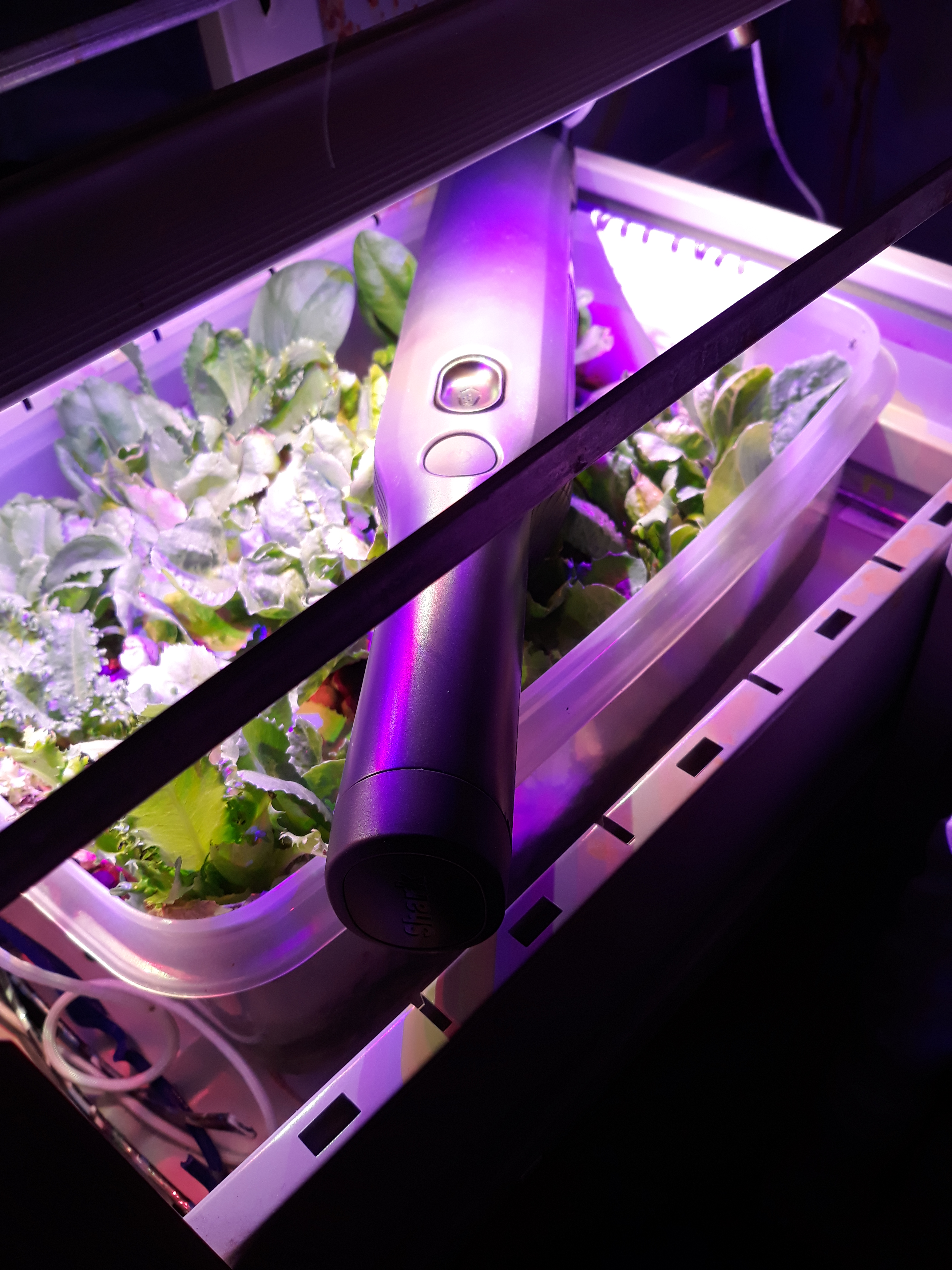
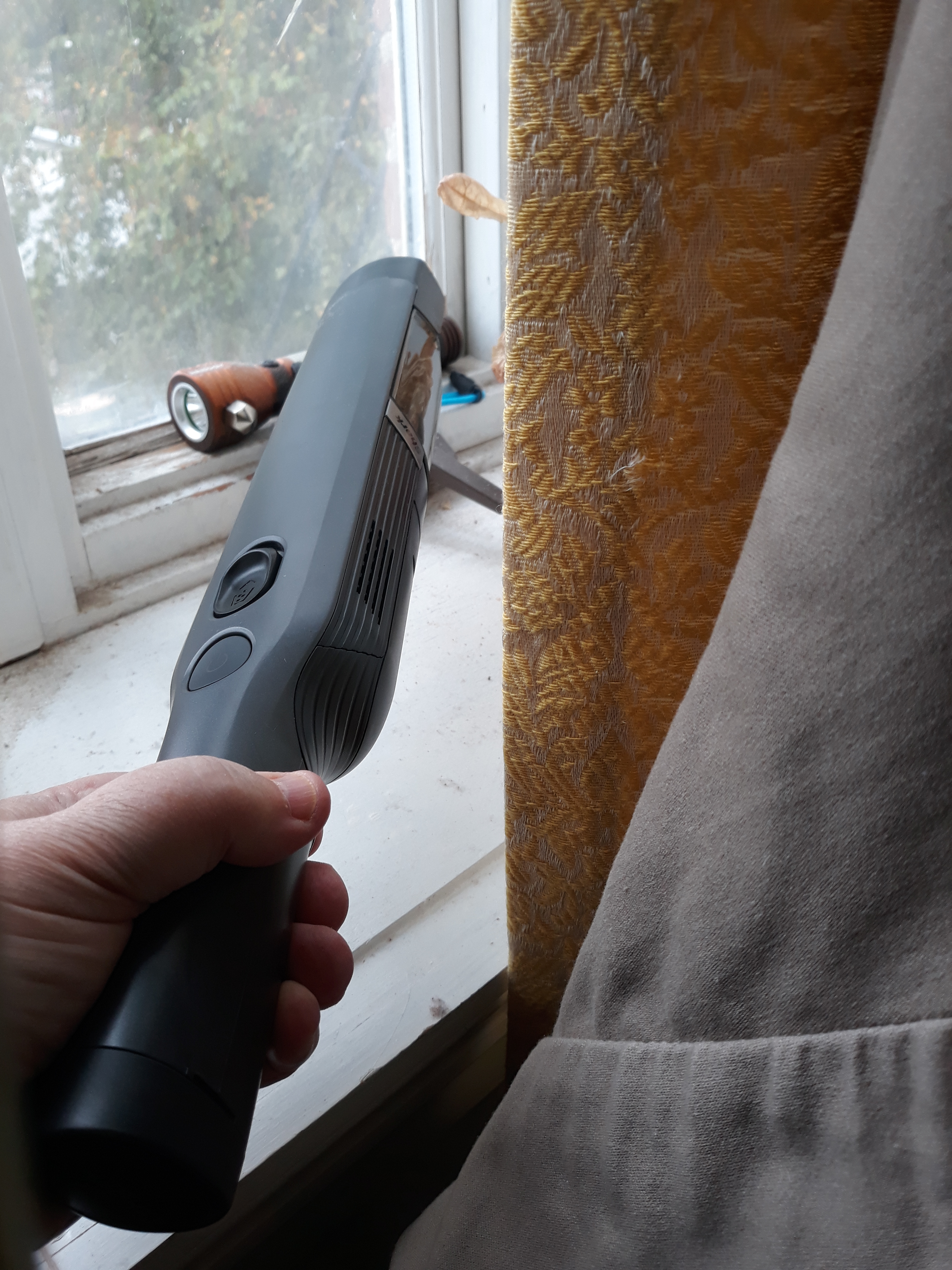
In the pictures above you can see my current hydroponic empire – a Tupperware container in the upper drawer of an old file cabinet – and yes, I should do a separate blog post on that. One of the big benefits of having this hydroponic setup in a file cabinet is the complete lack of pests even though I’ve been growing food in there for more than 6 months and have had serious pest problems when growing food in other parts of the house. A couple weeks ago I noticed really tiny black bugs were crawling around in my lettuce empire, and I was quite surprised – how could they have gotten there?? I got that answer about a week later when I suddenly had a large contingent of tiny flying black bugs rise up like a dark cloud when I opened the file cabinet drawer to inspect the crop. I tried killing them by hand, which had a pretty low success rate, and then I remembered the vacuum that I had purchased for squash bugs. Voila! Victory over diabolical bugs was swift with my vacuum! What a feeling of satisfaction; not something I feel all that often related to gardening.
I bought this lightweight vacuum off of Amazon.com but it’s probably available from a lot of places. At only about a pound and a half in weight this vacuum is super easy to use even with my arthritic hands. This is the first time I’ve used it to murder my enemies, but it sure worked well with this first try.
Solar That Survives Hurricanes? An Update.
60 Minutes did a report on how the Bahamas are upgrading their electrical grid to better handle the increasingly violent and increasingly frequent hurricanes hitting their low-lying islands. I was very concerned about Puerto Rico and other Caribbean islands installing solar panels, because of my concern about whether the solar panel installations would survive the brutal hurricanes that roll through that region fairly often. Well, hurricane Fiona just provided a data point – and the legacy electrical grid failed spectacularly, while the solar installations seem to have weathered the storm fairly well. I have to admit that I’m a bit surprised. I’ll wait for more information as the years go by, but this is good news for the hurricane-plagued Caribbean region. The non-profit organization Casa Pueblo says that their solar PV installation is helping the residents of Puerto Rico today, as usual, even after a hurricane. Here’s a link to a tiktok video talking about how solar panels are being installed, albeit slowly, in one town in Puerto Rico, and how the businesses who got solar panels installed by a foundation (presumably at no charge to them? Not sure) are charging themselves for the energy produced and re-investing that money into the community, to help residents. That’s good solar news all around! Solar panels are a superior choice even in regions with frequent severe weather. 🙂
Mint Orange Tea, Made From Scratch, Doesn’t Taste Or Smell Like Either Mint Or Orange. :(

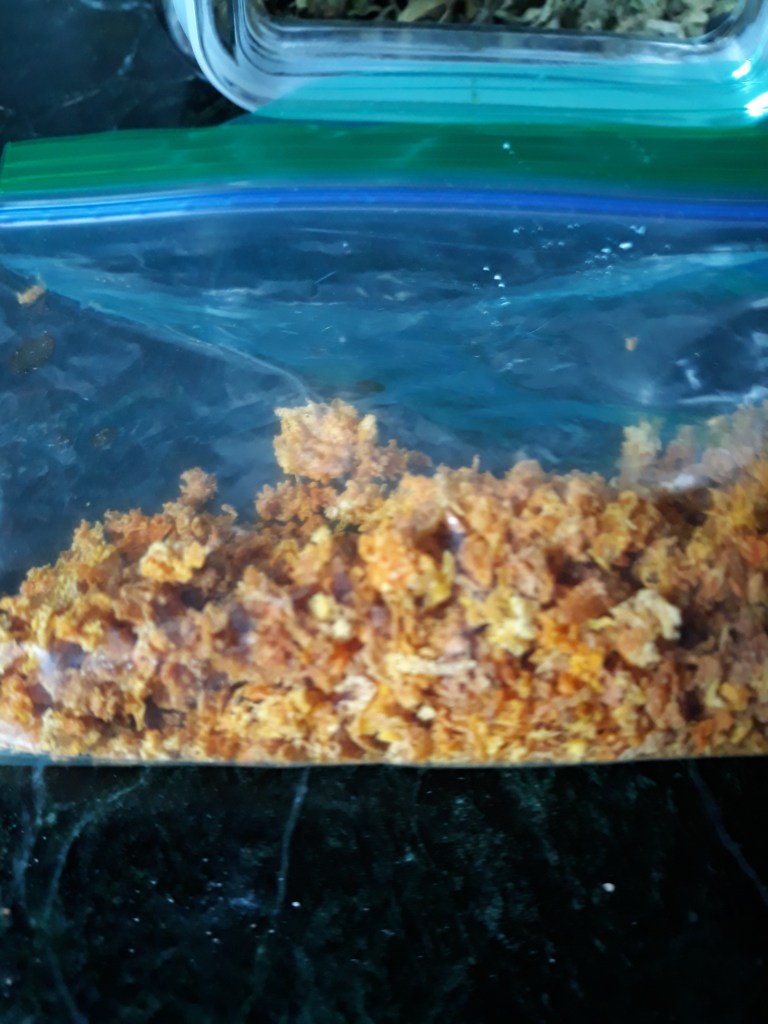
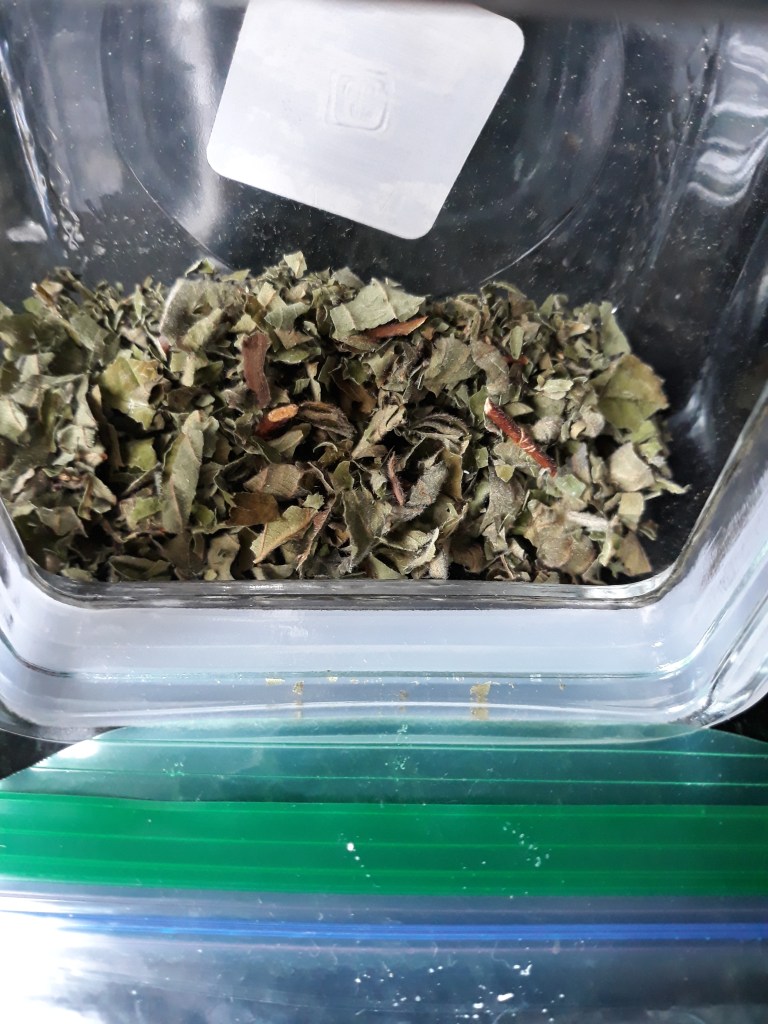
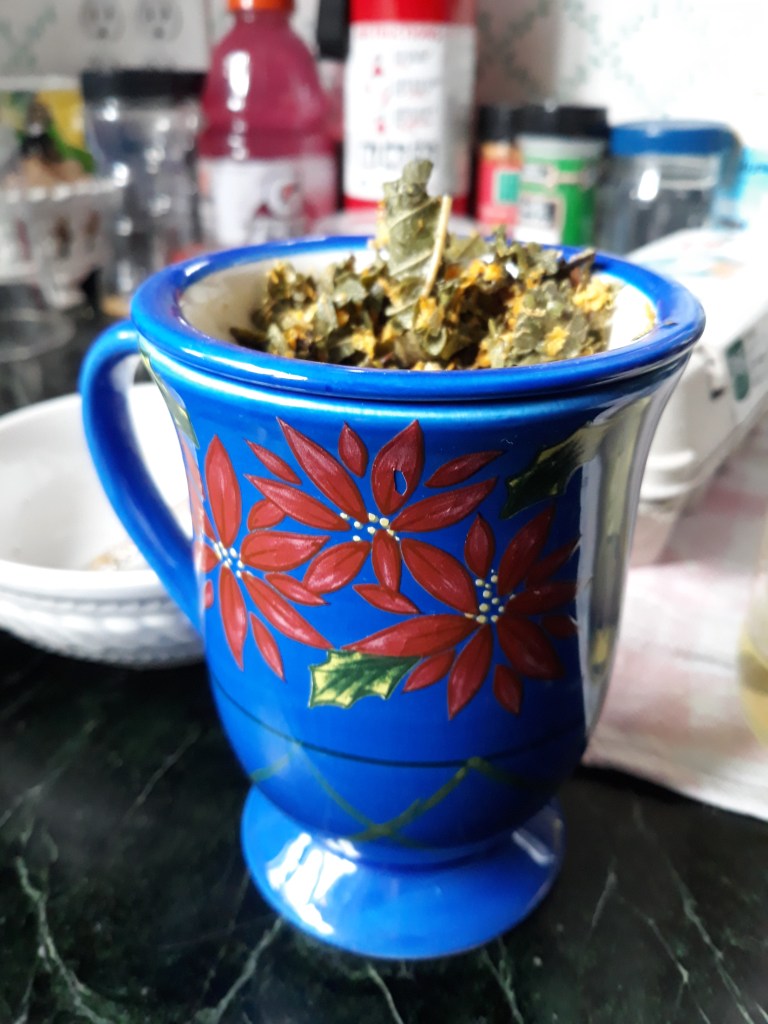
Granted, I spend WAY too much time on youtube, but after watching some videos praising homemade teas, specifically orange tea and mint tea, I decided to give it a go for myself. Doesn’t mint orange tea sound delightful?? It did to me. We raise plenty of organic mint in our garden, and we buy organic oranges (when we can find them!), so I grated the zest of a bunch of organic oranges, picked a bunch of mint, and dried it all. Made tea in the usual way, by putting a couple teaspoons of zest and dried mint in a tea strainer, made tea with great anticipation, and was mightily disappointed. I won’t drag you through my various experiments, but eventually even the large amounts of mint and orange zest shown in the pictures above didn’t make the tea as aromatic as initially hoped. I’m just guessing, but they probably do provide some health benefits when brewed? I can’t prove that, of course. I’m going to keep adding mint and orange zest to my tea along with some black tea, heavy cream and homegrown stevia, in the hope of deriving some health benefit.
Sharing Solar-generated Electricity in Bangladesh – Could This Be Useful In The U.S.?
I saw a pretty interesting youtube video about a system (hardware and software) being sold in Bangladesh which links multiple solar PV systems together to form a mini-grid for off-grid people. And here’s a link to an article that explains the details of SolShare’s system. According to the youtube video almost 20 million in Bangladesh use solar power now, and Bangladesh has one of the largest number of solar PV systems in the world; I haven’t verified if that’s actually true or not, so don’t quote me. A company named SolShare has developed a piece of hardware and associated software to allow customers to form Peer-to-peer microgrid systems. One of the crucial services provided by SolShare’s system is the ability of people who are sharing electricity with their neighbors to be able to accurately charge their neighbors for electricity that leaves the solar PV owner’s system. It seems like a great idea, and theoretically should work well in Bangladesh – but is there any instance where this would work well in the United States? For this to work, you’d have to have a lot of people who are off-grid living quite close to other people living off-grid. I don’t think that’s common now, but maybe eco-villages might have an interest in this type of technology? Peer-to-peer sharing of energy between households is pretty far off in the United States, but this is an interesting concept.
Grid Down? Electric Cut Off? You’re Camping now!
I was pretty impressed by something my brother did last fall, and it was a light bulb moment for me. He was checking out some rural land that he intends to buy and decided to live in the falling-down house on that land for several weeks but the utilities were turned off. He has done so much camping that living off the grid for several weeks was no problem. When he was indoors he spent most of his time in one room and used a small propane powered heater for heat, for light he used his battery-powered light from a tool set that he already owned, and the radio from that tool set also had a micro USB port he could use to charge his cell phone and his iPad, as well as play the radio. He also had a small battery bank that he used for some charging. He had a propane powered cook stove to cook his food, he hauled in jugs of water, and used a lot of non-perishable food except for some things in a super-efficient cooler that only needed fresh ice every couple of days. He was able to go to a neighbors house twice a week to recharge the batteries he needed for the light and radio/charger. He was able to drive to a convenience Mart some miles away to get fresh ice and food. I think the propane tank he used lasted for quite a few days, and he was using the sort of small propane tank that’s easily available and often used for BBQ grills. He was comfortable and well fed as he checked out that property, and I think that’s a pretty good example of how you, too, can be comfortable in a grid-down or utilities-off situation. This presumes that you can get someplace to charge your batteries, so doesn’t apply to all situations, but I thought it was a good concept.
This applies more to a temporary grid-down situation than to having your utilities shut off, but you really can be off-grid in a basic way and still be comfortable. You would want to either have a smaller room (maybe 10′ x 10′) where you could close all your doors or be able to put plastic up in any doorways that didn’t have a door in them, in order to be heating a smaller space, which requires a lot less energy/fuel (in other words, less propane). If you are without grid power in a standard american house and the temperatures outside are near or below zero you may have to winterize the rest of your house – drain the water lines, put anti-freeze in your toilet tank and bowl, drain the water line going to your refrigerator. That would be more necessary in an extended power outage – if the temperatures in the house get to below freezing any sitting water is likely to expand and break things. If you had hot water heat, you’d need to drain that system too.
If you’re living just-off-grid (you don’t have utilities but places accessible to you still have utilities) your best bet for showers is to go elsewhere – a gym membership is often quite inexpensive, and would include all the hot water showers you would like. Laundry can be done elsewhere.
If you’re trying to live off-grid in the summer heat a fan is your best bet since air conditioning takes so much power.
If you were going to be just-off-grid for an extended time, I would highly recommend either buying or building a solar oven. There are lots of examples of solar ovens that you can build yourself on youtube.com – though if you can buy one you’ll probably really appreciate the power and convenience of a professionally made oven.
And yes, there’s always the waste disposal issue – as in, human waste. If this is a very short term situation, a trash bag in a trash can can be utilized. For longer term comfort, a 5 gallon bucket, a toilet seat and sawdust are probably your best bet. People do compost human waste, but you need to learn how to do it properly or you will have a stinky health hazard to deal with. There’s lots of info on this around the web.


 SolarRationalist